Ever felt overwhelmed by choices? Whether you're picking software for your business, a new gadget for your home, or even mapping out your next big project, the sheer volume of options can quickly turn excitement into decision paralysis. This is where mastering Key Features & Comparison Factors isn't just helpful—it's essential. It transforms complex decisions into clear, confident choices, helping you cut through the noise and pinpoint exactly what truly matters.
At a Glance: Your Blueprint for Confident Decisions
- Comparison Tables are Your Secret Weapon: They distill complex information into easy-to-digest formats.
- Know When to Use Them: Ideal for 2-5 distinct options or similar products with critical differences.
- Avoid Overload: Don't use them for too many options or too few differences; simplicity is key.
- Design with Purpose: Every table needs a clear goal, whether it's upselling or market research.
- Prioritize the User: Focus on features most relevant to their needs, not just your marketing agenda.
- Go Beyond Features: Compare performance, cost-value, and user experience for a holistic view.
- Make it Accessible: Ensure your comparisons are usable for everyone, across all devices.
- Always Call to Action: Guide users to their next step once they've made an informed choice.
Decoding the Decision Dilemma: Why Features and Comparisons Matter
In today's crowded market, every product, service, or solution boasts a dazzling array of functionalities. But a long list of features doesn't automatically mean value. The real challenge lies in discerning which of these features are truly key for your specific needs, and how they stack up against competing options. This process of identifying Key Features & Comparison Factors is the bedrock of intelligent decision-making.
Think of it as creating a personalized cheat sheet. You're not just scanning bullet points; you're actively evaluating what makes one option stand out, what its limitations are, and how it aligns with your goals. This proactive approach saves time, reduces buyer's remorse, and ensures you invest wisely.
What Exactly Are We Comparing?
Before diving into tables, let's clarify what "key features" and "comparison factors" truly encompass:
- Key Features: These are the core functionalities or characteristics that differentiate one product or service from another. They are the "what it does" and "how it works" elements that directly impact its utility and value. Examples include processing speed, storage capacity, specific software integrations, or unique service offerings.
- Comparison Factors: These are the broader criteria you use to evaluate and weigh different options. While features are a subset, factors extend to areas like pricing structure, user experience, customer support, scalability, security, reputation, and long-term cost of ownership. They provide the lens through which you assess the overall value proposition.
By separating these, you gain a clearer framework. A product might have a killer feature, but if its pricing model is unsustainable or its user experience is clunky, the comparison factor evaluation will flag those concerns.
The Power of the Comparison Table: Your Visual Navigator
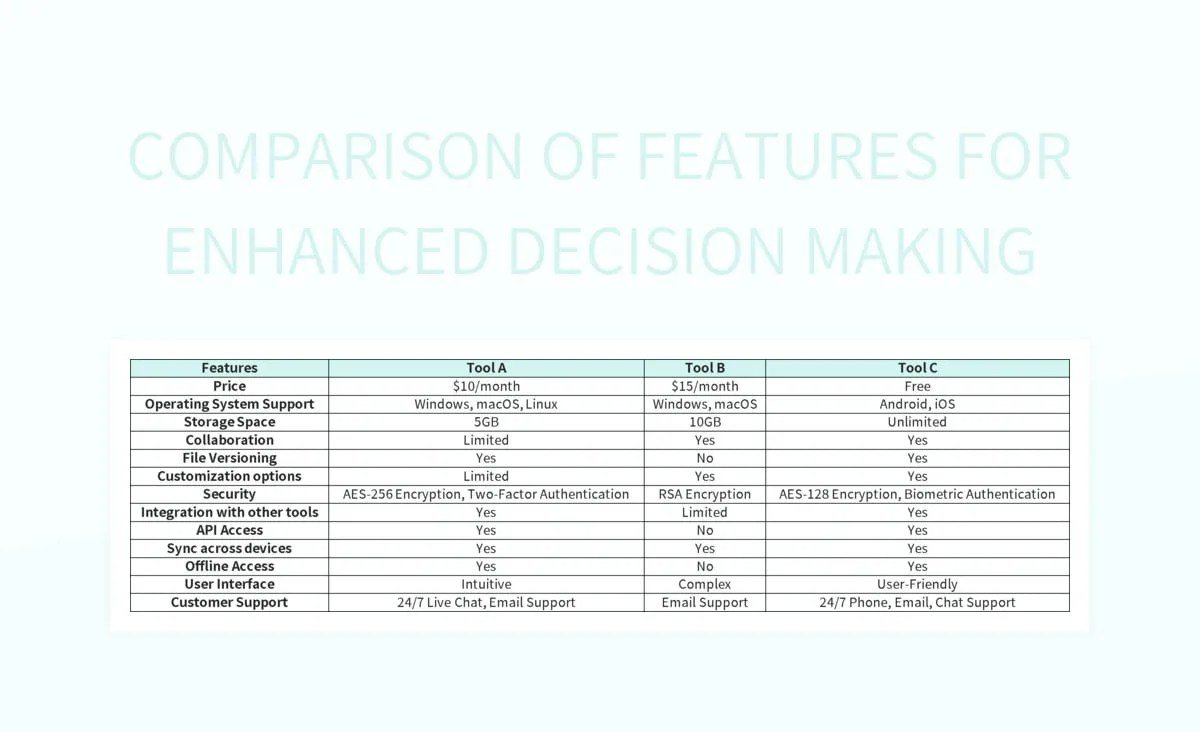
At its heart, a comparison table is a sophisticated decision-making tool. It lays out common features or characteristics in an easy-to-read format, empowering you to weigh pros and cons with clarity. Essential information often spans price points, technical specifications, or specific features, meticulously highlighting both similarities and critical differences.
When to Roll Out the Comparison Table
These tables aren't a one-size-fits-all solution, but when applied correctly, they are incredibly powerful:
- Multiple Distinct Options: When you have 2-5 choices, each with a clear, distinct value proposition. Think of software tiers like Basic, Pro, and Enterprise, where features escalate with price.
- Subtle But Critical Differences: Ideal for similar products or services (like electronics, subscription plans, or different SaaS tools) where the nuances can make or break a decision.
- Highlighting Unique Selling Points (USPs): They excel at showcasing what truly makes one option superior or different from its rivals.
- Transparent Communication: Use them to clearly outline feature limitations or capabilities across various offerings.
When to Pump the Brakes: Avoiding Comparison Overload
Sometimes, a comparison table can do more harm than good:
- Overwhelming Complexity: If you're comparing more than six products with fifteen or more features, a static table can quickly become a dense, confusing mess. Here, dynamic filters, interactive tools, or progressive disclosure (showing details only when requested) are far more effective.
- Minimal Differences: If most features are identical or non-critical across options, a table adds unnecessary clutter. A concise text summary might be better.
- Lack of User Value: Don't list features that don't genuinely matter to the customer. Irrelevant data only distracts.
- Too Few Options/Features: For two items with only a couple of features, a simple paragraph often suffices.
The Two Main Types: Static vs. Dynamic
Comparison tables come in different flavors, each suited for specific contexts:
- Static Comparison Table: This is your traditional, fixed-information display. Once published, the user can't interact with it to change what's shown. It's perfect when the information is stable, the number of options is limited, and you want to present a clear, unchanging overview.
- Dynamic Comparison Table: These tables allow users to interact with the data. They can select products to compare, filter by specific features, or sort by criteria like price or performance. Dynamic tables are invaluable when dealing with numerous products or services, requiring users to sift through data to find their ideal match.
The Anatomy of a Smart Comparison: Your Step-by-Step Guide
Crafting an effective comparison isn't just about listing data; it's about strategic presentation.
1. Define Your Purpose and Audience
Before you even think about data, ask yourself:
- What's the goal? Are you trying to upsell users to a higher tier, help them differentiate between competitor products, or simply outline the different capabilities of your own offerings?
- Who is it for? Understanding your target audience—their technical knowledge, their priorities, and their pain points—will dictate which features to highlight and how to explain them.
2. Gather Data with Precision
Accuracy is paramount. Your comparison is only as good as the information it presents.
- Cast a Wide Net: Collect data from diverse, reliable sources. This includes product manuals, official websites, customer reviews, industry reports, and thorough competitor analysis.
- Focus on Relevance: Prioritize accurate, up-to-date data. Think prices (and their payment structure: monthly/yearly), performance specifications (e.g., speed, capacity), and unique features. Disregard anything that doesn't genuinely help a user decide.
3. Organize for Clarity: Structure and Format
How you present the data directly impacts readability and comprehension.
- Logical Structure: Use clear headings and subheadings. A common approach is to list categories (e.g., "Performance," "Pricing," "Support") in a left-hand column, with details for each product or plan filling the columns to the right.
- Pillar Format: For very comprehensive comparisons, a pillar format can work, where each product gets its own dedicated section, and you cross-reference features. This is particularly useful for in-depth evaluations, much like how you might approach researching for Your ultimate sportsman generator.
- Consistency is King: Ensure all data points are formatted consistently. If one price is "$19/month," don't list another as "20 dollars per month."
Beyond the Basics: Advanced Principles for Savvy Comparison
While tables are great, the process of comparison extends far deeper.
1. Identifying Key Comparison Criteria
This isn't just about features; it's about the entire decision ecosystem.
- Holistic View: Go beyond basic features. Consider functionality, user experience, technical specifications, support, and hidden costs.
- Weighted Importance: Not all factors are equal. Weight them based on your (or your audience's) specific needs. For a developer, API access might outweigh UI aesthetics; for a general user, the opposite might be true.
2. Gathering Comprehensive Data (Quantitative & Qualitative)
Your data needs to be both broad and deep.
- Multiple Reliable Sources: Don't just rely on marketing material. Seek out independent reviews, expert analyses, user forums, and real-world performance metrics.
- Both Sides of the Coin: Collect quantitative data (speed, price, capacity) and qualitative insights (ease of use, customer service quality, community support).
3. Analyzing Feature Sets with Nuance
It's not enough to know if a feature exists; you need to understand its impact.
- Interoperability: How do features work together? Do they integrate seamlessly?
- Practical Application: What real-world problems does this feature solve?
- True Value Proposition: Does the feature genuinely add value, or is it merely a gimmick?
4. Evaluating Performance Metrics
Numbers tell a story, but only in context.
- Contextual Assessment: Evaluate speed, efficiency, reliability, and other quantifiable aspects within the context of specific use cases. What's fast enough for one task might be too slow for another.
- Benchmarking: Compare metrics against industry standards or direct competitors to gauge relative performance.
5. Assessing the Cost-Value Relationship
The sticker price is rarely the full story.
- Total Cost of Ownership (TCO): Factor in initial price, long-term maintenance, potential upgrades, training costs, and ongoing support subscriptions.
- Value Delivered: Pit the TCO against the actual value the product delivers. A cheaper option might end up costing more in productivity losses or hidden fees.
6. User Experience Considerations
Even the most powerful features are useless if no one can use them.
- Ease of Use: How intuitive is the product? What's the learning curve?
- Accessibility: Can diverse user groups, including those with disabilities, easily interact with it?
- UI/UX Design: Is the interface clean, logical, and aesthetically pleasing?
7. Making Data-Driven Decisions
Synthesize your findings to form an objective conclusion.
- Weighing Factors: Use your predetermined weights to score options against each criterion.
- Trade-off Analysis: Acknowledge that no single option is perfect. Understand the compromises you're making.
- Structured Frameworks: Employ decision matrices or scoring models to move beyond gut feelings.
8. Documentation and Reporting
This step is often overlooked but crucial for future reference and team alignment.
- Clear Reports: Document your comparison methodology, detailed findings, and final recommendations.
- Stakeholder Communication: Present your insights clearly to relevant parties, ensuring everyone understands the basis of the decision.
Designing for Impact: UX Best Practices for Comparison Features
A well-designed table isn't just informative; it's a pleasure to use.
Prioritize Clear Information Architecture
- User-Centric Ordering: Structure your tables to prioritize features most relevant to the user's decision-making process, rather than your internal marketing goals. For instance, "Number of Users" or "Core Functionality" should typically come before "Add-ons" or "Custom Integrations."
- Logical Grouping: Group related features under clear headings (e.g., "Performance," "Security," "Support").
Display Prices Clearly and Transparently
- Explicit Details: Always indicate monthly, yearly, or one-time payment options.
- Toggle Options: If applicable, offer an easy toggle for users to switch between monthly and yearly pricing, highlighting any cost savings for longer commitments.
- Consistent Formatting: Stick to a single format, e.g., "$19/month," not a mix of symbols and words.
Expand Row Height for Readability
- Whitespace is Your Friend: Generous row height prevents the table from looking cluttered and makes it easier for the eye to track information across columns. Avoid cramming too much text into a single cell.
Use Row and Column Separators Strategically
- Subtle Guidance: If you use separators, make them light-colored. Their purpose is to subtly guide the eye, not to create visual noise that competes with the data itself. Sometimes, sufficient whitespace is enough.
Visually Highlight Key Differences
- Focus the Eye: Use color, bolding, or distinct icons to draw attention to important differentiators.
- "Only Show Differences" Feature: For dynamic tables, offering an option to "only show differences" is incredibly useful, allowing users to quickly pinpoint what sets one option apart.
Add Visuals if Appropriate
- Simple & Universal: Use simple, universally understood graphics, images, or icons (e.g., checkmarks, "X" marks, stars for ratings) to illustrate information. These visuals can significantly improve scanability and comprehension, especially for complex technical specifications.
Reaching Everyone: Responsive Design & Accessibility
Your comparison should be usable by everyone, everywhere.
Responsive Design for Comparison Tables
Given that many users will access your comparison on mobile devices, responsive design is non-negotiable.
- Horizontal Scrolling: For tables with many columns, enable horizontal scrolling on smaller screens. Provide subtle visual cues like faded edges, arrows, or gradients to indicate more content is available.
- Collapsible Components (Progressive Disclosure): Display only the most critical information by default. Allow users to expand sections or individual rows for more detailed specifications. This reduces cognitive load on smaller screens.
- Keep Group Labels Visible: As users scroll horizontally, ensure that column headers or group labels remain sticky and visible. This maintains context and prevents users from losing their place.
Incorporate Interactivity for Better Usability
Beyond responsive design, interactive elements enhance the user experience.
- Hover States: Highlighting rows or cells on hover helps users focus on specific data points without losing their place.
- Sorting: Allow users to reorder rows or columns based on criteria they care about most—price (low to high), feature availability, or performance metrics.
- Filtering: Enable users to hide or show specific features or plans. This is particularly useful for complex tables where users only need to see features relevant to their current task.
Accessibility Considerations
Making your tables accessible ensures a wider audience can benefit.
- Semantic HTML Tags: Use
<thead>,<tfoot>, and<tbody>to properly structure the table for screen readers. The<table>element with<th>(table header) and<td>(table data) elements is fundamental. - Image Alt Text: Provide concise and descriptive alternative text for all images and icons. Screen readers rely on this.
- Descriptive Links: Ensure any links within your table (e.g., "Learn More," "Sign Up") have descriptive text that makes sense out of context, informing users where the link will take them.
- Keyboard Accessibility: Users should be able to navigate the entire table using only the keyboard (tab key, arrow keys, spacebar/enter). Ensure a logical left-to-right, top-to-bottom flow.
- Captions: Use the
<caption>element to provide screen readers with an overall identification and navigation context for the table. This is distinct from a heading and describes the table's content.
Making Your Comparison Compelling: Persuasion Tactics
An effective comparison doesn't just inform; it nudges users toward a confident decision.
Use Information from Reliable Sources
- Build Trust: Reference industry reports, independent customer surveys, or third-party reviews. Explicitly citing sources adds immense credibility.
- Avoid Bias: Strive for objectivity. While you want to persuade, overtly biased comparisons undermine trust.
Prioritize Data Relevancy
- Highlight Differentiators: Focus on the features and factors that truly distinguish options.
- Limit Noise: Ruthlessly cut identical or non-critical information that doesn't add value to the decision. If every product has 24/7 support, it might not be a differentiator worth highlighting.
Leverage Data Visualizations
- Simplify Complexity: Use charts, graphs, or intuitive metrics to simplify and interpret quantitative data. Instead of just a number, show a progress bar or a star rating.
- Visual Storytelling: Help users grasp complex data at a glance.
Include Benefits and Reviews
- Emphasize Impact: Translate features into benefits. Instead of "12GB RAM," write "Blazing Fast Multitasking for demanding applications."
- Social Proof: Incorporate customer reviews, testimonials, or aggregated ratings directly into the comparison to build confidence and provide real-world validation.
Use Clear Calls-to-Action (CTAs)
- Guide the Next Step: Include strong, context-relevant CTAs at the end of the table or within individual table cells (e.g., "Start Free Trial," "Request Demo," "Contact Sales," "Buy Now"). Make the path forward obvious.
Real-World Inspiration: Comparison in Action
Let's look at how some companies effectively leverage these principles:
- Resend: When comparing transactional email services, Resend uses an interactive slider that dynamically highlights relevant pricing plans as you adjust your anticipated email volume. This significantly reduces cognitive load by showing only what's pertinent to your specific needs.
- Framer: This website builder employs smart comparison tactics like a toggle for monthly/yearly pricing, clearly highlighting the savings for an annual commitment. Crucially, their pricing cards and CTAs remain sticky and visible as you scroll, ensuring the path to purchase is always accessible and persuasive.
These examples underscore that effective comparison isn't just about data, but about a seamless, intuitive, and persuasive user journey.
Common Questions & Misconceptions About Feature Comparison
"Should I always include every single feature a product has?"
No, absolutely not. This is a common pitfall. Focus on key features that are differentiators and genuinely matter to your audience. Overloading a comparison table with identical or irrelevant features creates clutter and decision fatigue. The goal is clarity, not comprehensiveness at all costs.
"Is it okay to only compare my product against competitors?"
While comparing against competitors is crucial, don't neglect comparing different tiers or versions of your own product. Many users need help deciding between a Basic, Pro, or Enterprise plan. Both internal and external comparisons serve different, but equally important, purposes.
"What if a feature isn't directly comparable across two products?"
If a feature exists in one product but not another, or has a completely different implementation, be transparent. You can use "N/A," "Not Available," or a brief explanation of an alternative solution offered (or not offered). Don't try to force a comparison where none naturally exists; it can mislead users.
"How do I make sure my comparison is unbiased?"
Strive for objective language, back claims with data, and cite sources. If comparing your own product, resist the urge to exaggerate its strengths or downplay competitors' advantages. While you want to present your product favorably, an overtly biased comparison will erode trust. Consider including testimonials or third-party reviews for external validation.
"My product has so many features, the table is huge. What now?"
This is a sign to re-evaluate. Use progressive disclosure: show a high-level overview, then allow users to expand sections for more detail. Implement filters and sorting options. Consider breaking down a very large comparison into smaller, themed comparison tables (e.g., "Performance Comparison," "Integration Comparison").
Your Next Step Towards Smarter Choices
Mastering Key Features & Comparison Factors is more than just a task; it's a critical skill in today's information-rich world. Whether you're guiding customers through your product line or making a pivotal business decision yourself, the principles we've discussed empower you to navigate complexity with confidence.
Now, take this knowledge and apply it. Start by defining the purpose of your next comparison, gather your data diligently, and design with your user's clarity in mind. Remember, the goal isn't just to present information, but to facilitate informed, confident decision-making. Make every comparison a stepping stone to a better choice.